
Sewing Machine Needles: Which Type and Size for Which Fabric
NeedleAndHoop is reader-supported. If you buy through our links we may earn a commission at no extra cost to you. As an Amazon Associate we earn from qualifying purchases. Disclosure.
A worn or wrong needle causes a surprising number of sewing problems. SCHMETZ lists the signs: frayed or breaking thread, skipped or uneven stitches, puckered seams, damaged fabric, and a popping sound as the needle goes through. Here's how to pick the right one, using SCHMETZ's 2024 needle guide and SINGER's help center.
How needle sizes work
Packs usually show two numbers, like 90/14. SCHMETZ explains that the metric (NM) number is 100 times the blade diameter in millimeters (NM 90 = 0.9 mm), and the higher the number, the thicker the needle. The second number is the US size. SINGER puts it simply: the lighter the fabric, the smaller the needle; the heavier the fabric, the larger the needle.
Needle types (SCHMETZ)
| Type | What SCHMETZ says it's for | Sizes listed (NM) |
|---|---|---|
| Universal | Slightly rounded point for a wide range of materials | 60–130 |
| Jersey | Medium ball point for knitwear | 70–100 |
| Stretch | Elastic and highly elastic knits; helps prevent skipped stitches | 65, 75, 90 |
| Jeans | Denim and similar rigid wovens; reduces needle breakage and skipped stitches | 70–110 |
| Microtex | Very fine or densely woven fabrics, silk, microfiber, coated fabrics | 60–110 |
| Quilting | Slim point for thick layers; quilting and patchwork | 75, 90 |
| Embroidery | Wide eye and thread groove for embroidery thread | 75, 90 |
| Topstitch / Metallic | Long 2 mm eye for heavy or several threads / metallic thread | 70–100 / 80, 90 |
| Leather | Cutting point for leather; not for woven or knit fabric | 70–120 |
SCHMETZ says these are general recommendations and suggests testing on a scrap first. Some fabric pairings from its chart: linen, universal 80 or 90; jersey, jersey 70 or 80; patchwork, quilting 75 or 90; denim, jeans 70 to 110.
Needles worth keeping on hand
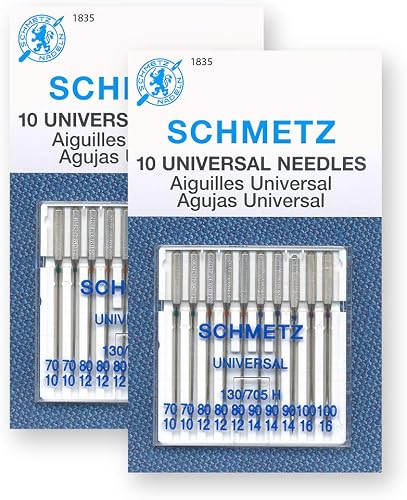
A pack of universals covers most woven fabric. SCHMETZ sells assorted-size cards and single-size 80/12 cards, per the listings.
SCHMETZ Universal Needles, Assorted Sizes (2 Cards)
- Two 10-needle cards of assorted sizes, per the listing
- Universal needle: slightly rounded point for woven and knit fabrics
- Sold by SCHMETZneedles
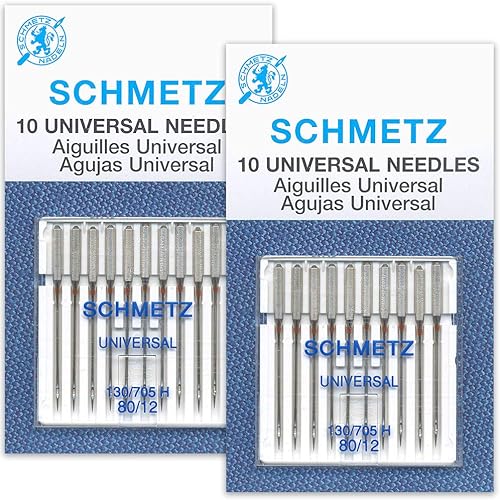
SCHMETZ Universal Needles, Size 80/12 (2 Cards)
- Two 10-needle cards, size 80/12, per the listing
- Slightly rounded point for woven and knit fabrics
For knits, a ball point set. SINGER's titanium pack has 80/11, 90/14 and 100/16, per the listing (SINGER labels the smallest 80/11).
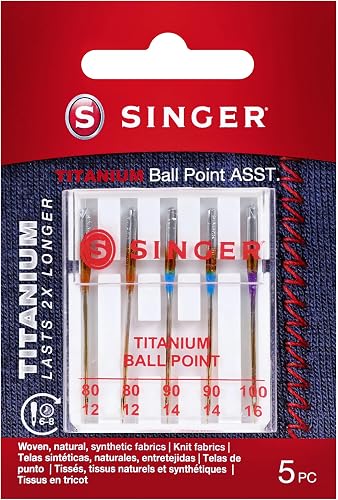
SINGER Titanium Ball Point Needles, 80/11-100/16 (5)
- Two 80/11, two 90/14 and one 100/16, per the listing
- Ball point for knit fabrics
- Titanium coated
For denim and leather, SINGER's heavy-duty pack has 90/14, 100/16 and 110/18, including a leather point. See also our heavy-duty machine guide.
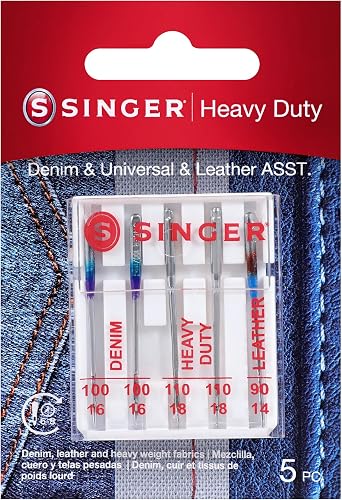
SINGER Heavy Duty Needles, 90/14-110/18 (5)
- Two 90/14, two 100/16 and one 110/18, per the listing
- Listed for denim, leather, vinyl, corduroy and heavy wovens
- Sharp point (blue) and triangular leather point (brown)
For machine embroidery, Brother sells 75/11 embroidery needles for selected Brother models; check your manual first.
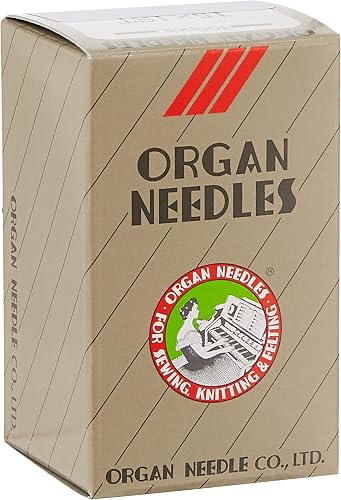
Brother SAEMB7511 Embroidery Needles, 75/11 (100)
- 100 embroidery machine needles, size 75/11, per the listing
- Flat-back shank; packed in sets of 10
- For selected Brother models; check your manual
When to change the needle
- SCHMETZ: after about 8 hours of sewing, or at the start of each new project.
- SINGER: after two to three garments, after hitting a pin, and in its FAQs, every 6 to 8 hours (another SINGER page says 8 to 10).
- Quick test from SCHMETZ: push the needle into old sheer tights. If it snags or pulls threads, retire it.
Putting a needle in
SINGER says the flat side of the needle shank faces the back of the machine. Check your manual, since some machines differ.
FAQ
How often should I change it?
About every 8 hours of sewing, or each new project.
What do the two numbers mean?
Metric size (blade diameter x 100) and US size.
Which needle for knits?
Jersey/ball point, or stretch for very elastic fabric.